Falling Through the Crack
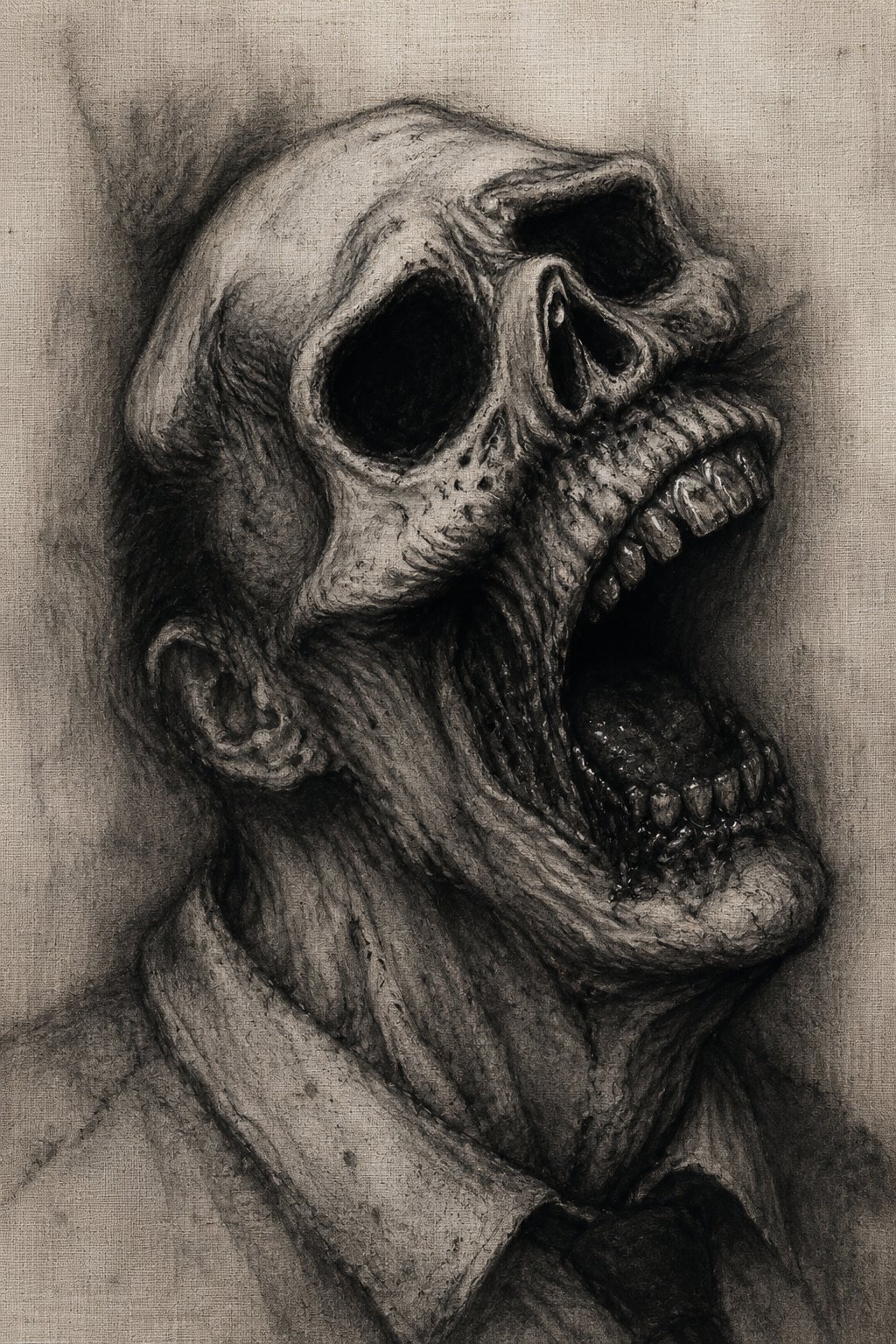
Human life has two respectable counters, like an old government office where the fan rotates with the philosophical indifference of a cow.
At the first counter, you help mankind use what mankind already knows. That is most work. You teach the syllabus. You sell the insurance. You repair the pump. You write the report. You maintain the bridge, the website, the medicine stock, the marriage, the account book, the family WhatsApp peace treaty. Civilization is mostly this: known things passed from tired hand to tired hand.
At the second counter, a few dangerous people discover something new. A theorem. A vaccine. A poem. A small adjustment to the map of reality. Nobody sensible plans this. You cannot wake up in Garia at 7:15, brush with Colgate, drink tea, and say, “By lunch I shall discover a new law of nature.” The universe is not Swiggy. It does not deliver enlightenment in thirty minutes with a discount coupon.
Then there is the third counter.
It has no clerk.
This is where some of us stand.
Or fall.
Falling through the crack sounds dramatic until it happens slowly. Then it becomes administration. One year you are promising. Next year you are “between things.” After that you become a story people lower their voices around. You are not unemployed exactly, not employed properly, not ruined enough to be tragic, not successful enough to be introduced loudly at weddings. You become a pending file with spectacles.
And in Kolkata, pending files know how to suffer. They sit under damp ceilings. They drink overboiled tea. They listen to neighbors discuss other people’s children as if each child were a share price. They watch the afternoon light fall on cracked plaster and think, with unnecessary literary ambition, that perhaps the cracked plaster is also watching them.
I am fifty-one. This is a dangerous age for a Bengali man who has read too much and earned too little. At twenty-one, poverty has romance. At thirty-one, it has excuses. At forty-one, it has strategy. At fifty-one, it begins to smell faintly of unpaid electricity bills and old ambition stored in a plastic folder.
You think time moves because clocks move.
Not quite.
Time moves when someone is waiting for you.
A school bell gives time legs. A salary gives time shoes. A train departure gives time a whistle and a cruel face. A doctor’s appointment, a bank deadline, a rent reminder, a mother calling from the next room—these things nail time to your day.
But when nobody is waiting, time becomes loose. It wanders. It sits on the edge of the bed scratching its chin. Monday and Thursday exchange clothes. Morning arrives without authority. Night comes not as a conclusion but as another unpaid installment. You stop counting because counting is for people with destinations.
This is where the mind begins its small circus.
It asks: am I falling, or is the world rising toward me?
This is not as foolish as it sounds. When you are inside a moving train, the platform appears to slide away. When you are inside failure, society appears to accelerate upward with suspicious confidence. Everyone is building, posting, launching, marrying, investing, optimizing, networking, announcing. You are still looking for your slippers.
Outside, the city continues with magnificent disrespect. Fish sellers slap hilsa on wet tables. Buses sigh black smoke like retired dragons. Election posters fade into the wall until leader and fungus become one democratic surface. A boy on a scooter carries three gas cylinders and the expression of a man who has already negotiated with death before breakfast. Somewhere a news anchor is shouting as if volume were evidence.
Meanwhile, your own body runs its little republic. Cells divide. Knees complain. Hair retreats from the forehead like the British from empire, except with less paperwork. The stomach makes policy announcements after oily food. The brain, that overpaid clerk, keeps opening old files: what you did, what you failed to do, who said what in 1998, why you did not answer properly, why you still remember a sentence that has forgotten you.
The crack is not empty. That is the surprise.
It is full of old gods, new markets, family expectations, patriotic slogans, career advice, motivational nonsense, aunties with forensic memories, and men who discovered meditation after making other people miserable for forty years.
I am an atheist, so I do not have the comfort of blaming the sky. This is inconvenient. Belief gives people a complaint department. I have only the ceiling fan.
Still, disbelief does not make the world simple. It only removes one layer of decoration. Underneath, humans remain wonderfully inventive in their foolishness. We can turn anything into a ritual. A story becomes a rule. A rule becomes a punishment. A punishment becomes tradition. Tradition gets a garland. Then everyone pretends the garland was always there.
This is how cruelty survives: not as cruelty, but as culture wearing clean clothes.
A woman’s obedience becomes family honor. A young man’s misery becomes discipline. A daughter’s fear becomes adjustment. A son’s failure becomes character defect. Poverty becomes laziness. Wealth becomes virtue. Loudness becomes leadership. Repetition becomes truth.
You think the villain is ignorance.
Often it is convenience.
Ignorance is a small matchstick. Convenience is the whole paraffin shop.
People believe what helps them avoid rearranging the furniture of their lives. A family will defend nonsense if the nonsense keeps the cupboard locked in the right person’s name. A society will worship a story if the story keeps the uncomfortable questions outside the gate. A nation will polish its myths until they shine brighter than its drains.
And yet, here is the irritating complication: stories are not useless.
We live by stories. Without them, we are just nervous animals wearing cotton. A good story can hold a person up. A bad story can hold a person down. The trick, which humanity has not mastered despite several thousand years of chanting, marching, printing, broadcasting, and forwarding messages with folded-hand emojis, is telling the difference before someone gets crushed.
That is where falling through the crack teaches you something.
From the official floor, systems look solid. Work, family, religion, education, success, respectability. Nice words. Heavy words. Words with furniture.
From the crack, you see the plumbing.
You see that work is not only dignity; it is permission to exist without explanation. You see that family is not only love; it is also memory, hierarchy, property, duty, guilt, lunch, and old emotional debt served with posto. You see that society forgives many sins if the person committing them has income. You see that failure is treated not as a condition but as a smell.
You also see yourself more clearly than you would like.
That is the nasty part.
It would be pleasant to say I am a misunderstood genius, but honesty is a stubborn street dog. It follows you home. I am not sure I was made for the first role, the honorable carrying of known things. I am not sure I was made for the second role, the lightning strike of discovery. I have intelligence, yes, but intelligence is not the same as fitness for the world. A sharp knife is useful in a kitchen and alarming in a pillowcase.
So what remains?
Observation.
That sounds small. It is not.
To observe without lying is already a kind of work. To describe the crack is to prove the floor is not continuous. To write from the pending tray is to say: look, here also life happened. Here also the afternoon had color. Here also the tea had too much sugar. Here also a man fell, grumbled, laughed, cursed privately, cleaned up the sentence, and sent back a report from the underside.
Maybe that is not a career.
Fine.
Not everything valuable is a career. Some things are weather reports from places respectable people avoid. Some things are lanterns left in broken stairwells. Some things are warnings scratched on the back of a bus ticket.
And perhaps usefulness comes late, wearing cheap sandals.
Perhaps the fallen person is not only debris. Perhaps he is a witness. A reluctant one. A bad-tempered one. A witness with back pain, unpaid subscriptions, and no patience for holy fraud or motivational wallpaper. But a witness still.
The clock has not stopped.
It was waiting to be noticed.
So I notice it.
Tick.
Tea cooling on the table.
Tick.
A crow arguing on the parapet.
Tick.
Another paragraph pulled from the crack before the crack closes its mouth.